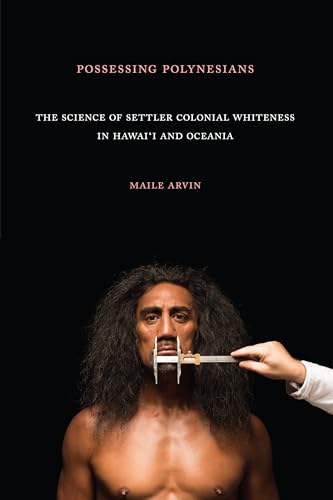
Possessing Polynesians: The Science of Settler Colonial Whiteness in Hawai`i and Oceania/ Maile Arvin
Material type: TextPublication details: Duke University Press; 2019Description: 328p; 23x15cmISBN:
 - 9781478006336
| Item type | Current library | Collection | Call number | Status | Date due | Barcode |
|---|---|---|---|---|---|---|
 Book
Book
|
SAF Reference Library | Political Science | JV61-152 80.181 (Browse shelf(Opens below)) | Available | 6502 |
Browsing SAF Reference Library shelves, Collection: Political Science Close shelf browser (Hides shelf browser)


Acknowledgments -------Introduction: Polynesia Is a Project, Not a Place 1 -------Part I. The Polynesian Problem: Scientific Production of the "Almost White" Polynesian Race 35 -----1. Heirlooms of the Aryan Race: Nineteenth-Century Studies of Polynesian Origins 43 ------2. Conditionally Caucasian: Polynesian Racial Classification in Early Twentieth-Century Eugenics and Physical Anthropology 67 -------3. hating Hawaiians, Celebrating Hybrid Hawaiian Girls: Sociology and the Fictions of Racial Mixture 96 -------Part II. Regenerative Refusals: Confronting Contemporary Legacies of the Polynesian Problem in Hawai'i and Oceania 125 --------4. Still in the Blood: Blood Quantum and Self-Determination in Day v. Apoliona and Federal Recognition 135 --------5. The Value of Polynesian DNA: Genomic Solutions to the Polynesian Problems 168 --------6. Regenerating Indigeneity: Challenging Possessive Whiteness in Contemporary Pacific Art 195 -------Conclusion. Regenerating an Oceanic Future in Indigenous Space-Time 224 -------Notes 241 --------Bibliography 279 -------Index
From their earliest encounters with Indigenous Pacific Islanders, white Europeans and Americans asserted an identification with the racial origins of Polynesians, declaring them to be racially almost white and speculating that they were of Mediterranean or Aryan descent. In Possessing Polynesians Maile Arvin analyzes this racializing history within the context of settler colonialism across Polynesia, especially in Hawai‘i. Arvin argues that a logic of possession through whiteness animates settler colonialism, by which both Polynesia (the place) and Polynesians (the people) become exotic, feminized belongings of whiteness. Seeing whiteness as indigenous to Polynesia provided white settlers with the justification needed to claim Polynesian lands and resources. Understood as possessions, Polynesians were and continue to be denied the privileges of whiteness. Yet Polynesians have long contested these classifications, claims, and cultural representations, and Arvin shows how their resistance to and refusal of white settler logic have regenerated Indigenous forms of recognition.
English
There are no comments on this title.